- Grade Level
- Middle school / junior high school (grades 5/6/7–8/9) from 11 to 15 years old.
- High school / Senior high school (grades 9/10–12) from 15 to 17/18 years old.
- High School / College Level / Girls, Women 16 -30 Art, Design, Human tech.
- Subjects
- Natural Sciences: material properties.
- Technology: 3D design and construction.
- Art: Modelling with 3D model.
- Mathematics: Measuring and classifying materials based on conductivity.
- Duration
Several days, could be implemented in lessons of 2 hours. Maximum 8 hours in total
- Learning Outcomes
This assignment is a collaborative project between science and mathematics. The learner can do this project alone or with a group of two or three people.
If you want to work in a group of three, the group can make two Tiny houses models at the same time.
Think carefully about who you will be working with in a group. Please note: Everyone fills in their own booklet and completes the assignments described in this booklet before moving towards making a 3D model of their own Tiny house.
Mathematics Learning Objectives, the learner will be able to:
- Know what an enlargement is
- Know what a magnification factor is.
- Calculate the factor at a magnification.
- Understand the concepts of original and image.
- Calculate the missing sizes with the factor.
- Calculate the circumference of a magnification.
- Calculate the area of an enlargement.
- Understand the concept: scale.
- Calculate the factor on the scale
- Calculate the scale.
Learning objectives science, learner will able to:
- Work with someone and hand in a joint end product.
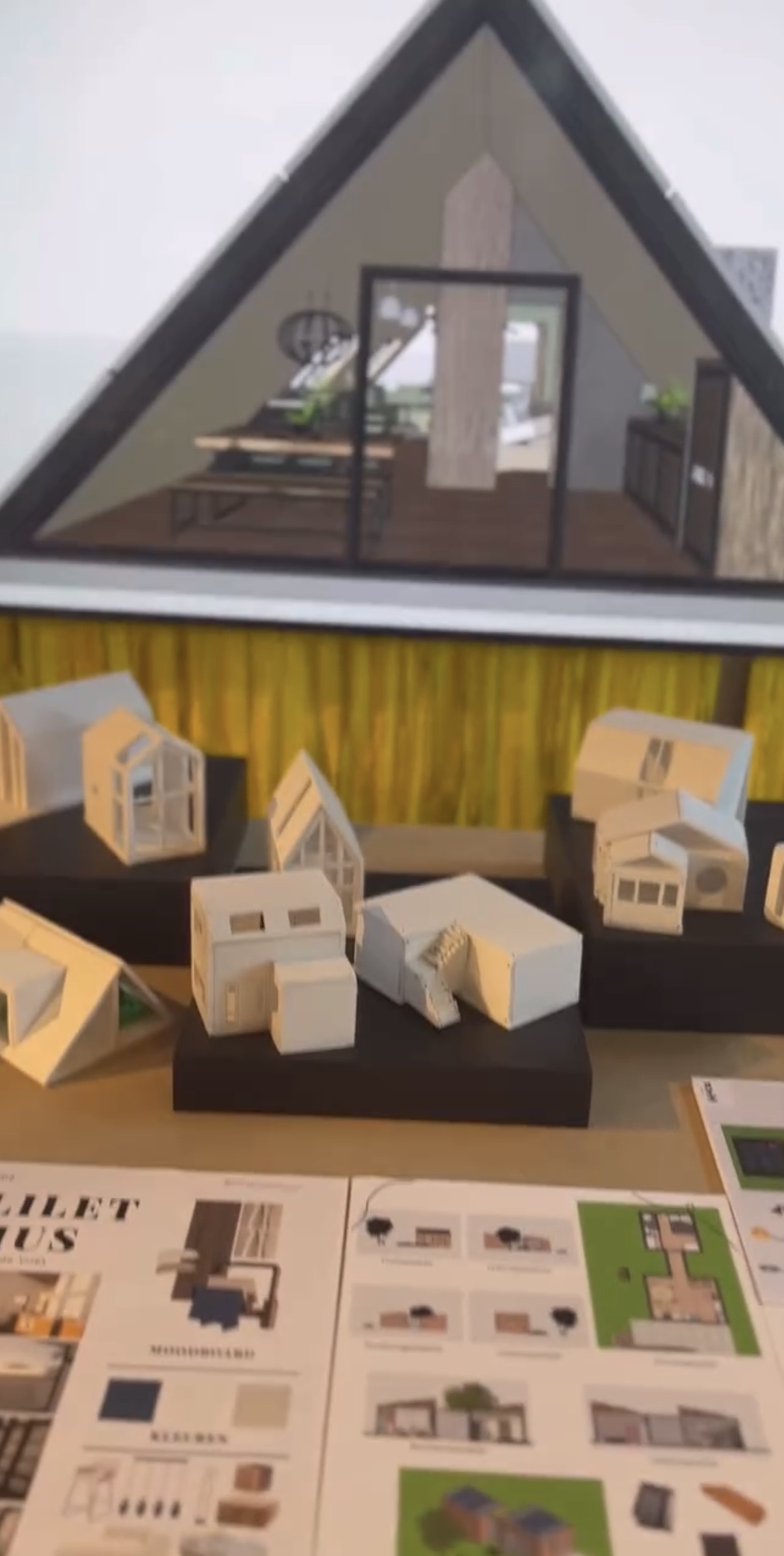
- Turn a 2D drawing into a 3D model.
- Make a logical layout of a house
- Work efficiently with cardboard and paper.
- Make connections between different materials.
- Understand the housing shortage within our society and that Tiny houses are a possible solution for the future.
- Understand the concept: scale.
- Calculate the factor on the scale.
- Calculate the scale.
- B&T dimensions and types covered
Dimension
- Interest in New Technology. The activity introduces students to basic 3D progresses simultaneously as they look at a possible live project.
- Appreciation and Respect: Understanding and respecting for natural elements of space, land and usefulness.
- Social Responsibility: Promoting inclusivity and empathy through researching the possibilities of using the houses
- Practical orientation: Students actively build and model their own Tiny house
Type:
- Explorer: Through the exercise the student get to manually work with tools that they are perhaps not use to and explore how to put together an item.
- Does: The lesson entails that the students have a hands on activity. Hand-on activity that combines following instructions and making the item.
- Teacher Prerequisite Knowledge
The teacher(s) for this lesson need a strong base in applied mathematics. Specifically, they need to be able to teach all the mathematics objectives listed above. Ideally, they have some understanding of architecture to help connect this lesson to real-life design.

- Materials
- Cardboard
- Sticker
- Wallpaper
- Glue
- Siccors
- Paint
- 3d prints
- Fabrics
- Foam paper.
- Pencils
- Paintbrushes
- Paper (sketching)
- A3 Sheet with squares
- floorplanner.com free program (or other like it, everyone needs to make an account)
- Lesson Plan
Introduction
Tiny houses are currently the solution to quickly place homes somewhere. Too few houses have been built in the Netherlands in recent years. At the same time, environmental requirements have become stricter and make it increasingly difficult to build quickly. Think of nitrogen problems and the protective measures for all kinds of plants and animals. Municipalities in the Netherlands are increasingly switching to the installation of temporary container homes to meet the need for more living space.
Tiny houses are small houses that have between 15 m2 and 50 m2 of living space, where you can live in. The houses are often made from shipping containers. These are relatively inexpensive to purchase and easy to stack. A container can easily be converted into a home in a large factory.
The construction time of a Tiny house is very short. The energy and water consumption are lower than ordinary homes and the homes take up much less space. All this contributes to a better environment and solves part of the housing shortage.
Step-by-step development
Research
You are now going to do research on the internet about Tiny Houses.
Answer the following questions:
(See downloads)
- Extension Activities
Possible to make this as big (extent) as you want, add lighting, roofing, in and outside decoration, plateau’s, veranda’s etc.